
Travel guide & FAQ
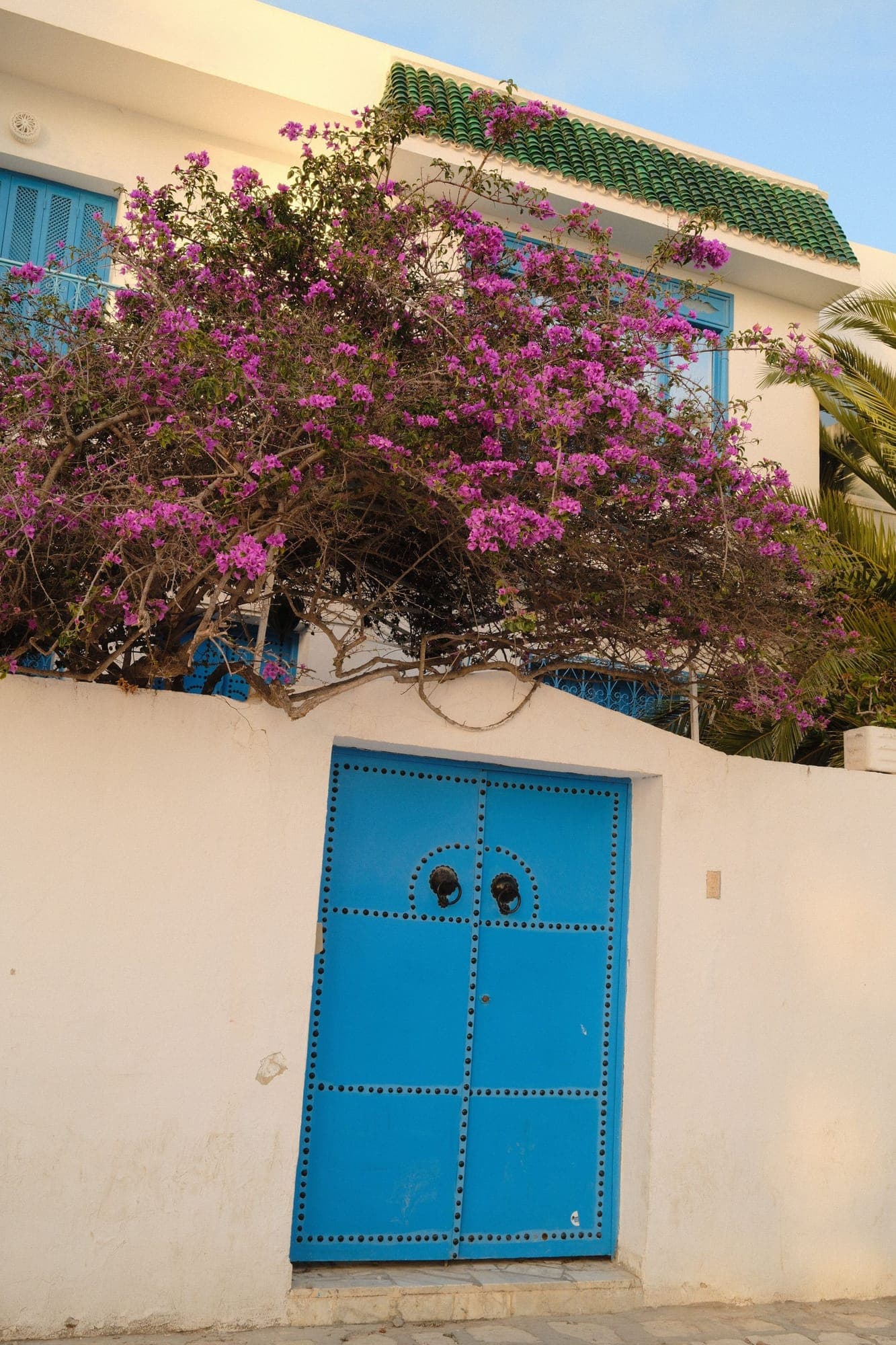
The blue doors of Sidi Bou Saïd, and what the studs mean
Sidi Bou Saïd is the most photographed village in Tunisia, and almost all of those photographs are of a door. Here is why they are that particular blue, what the ironwork means, and where the good ones actually are.
Why is Sidi Bou Saïd blue and white?
The blue-and-white palette is not ancient. It is generally credited to Rodolphe d'Erlanger, a French-born painter and musicologist who settled in the village and, in 1915, had a decree passed requiring buildings to be whitewashed with blue joinery. The village had been a cliff-top settlement of pilgrims and fishermen for centuries before that; the colour scheme is barely a hundred years old.
The blue itself is often called Tunisian blue — a strong cobalt closer to lapis than to sky. Traditionally it came from a pigment mixed on site, and it was used on shutters, grilles and doors while the walls stayed lime-white. The practical effect is that in hard Mediterranean light the white throws the glare and the blue absorbs it, which is why the village photographs so well between eight and ten in the morning.
What do the black studs on the doors mean?
The nails are the part visitors miss. Traditional Tunisian doors are studded with hand-forged black nails arranged in patterns, and the patterns are not decorative filler — they are a vocabulary. Fish appear as a protection motif, and geometric arrangements borrow from the same repertoire as tilework.
You will also notice most old doors have two knockers at different heights: a heavy one lower down and a lighter one above. The lower was for men, the upper for women, and the sound told the household who was outside before the door opened. On the finest doors the frame is set in a horseshoe arch and the whole assembly reads as one composition.
Doors this elaborate belonged to families who could pay for them, which is why the concentration is highest on the streets nearest the summit rather than at the bottom of the hill.
Where the best-preserved doors are
The main street up from the car park, Rue Habib Thameur, carries the most famous frontages and the most people. The doors are genuinely good; you will be photographing them over someone's shoulder.
Turn off it. The lanes running left towards the cliff edge — narrower, unsigned, mostly residential — hold doors in better condition with nobody in front of them. Dar El-Annabi, a family house open to visitors, lets you see how the door, courtyard and tiled rooms were designed as a set rather than a façade.
One request from people who live here: these are front doors of occupied houses. Photograph them, don't lean on them.
When to go, and what it costs
Before ten in the morning or after five in the afternoon. Sidi Bou Saïd is a standard stop for coach tours and cruise excursions, and between eleven and three the main street is a queue. Early light is also better on the blue.
Entry to the village is free. The cafés on the cliff — Café des Nattes at the top of the steps and Café Sidi Chabaane on the terraces below — charge a few dinars for mint tea with pine nuts, and the view from Chabaane over the Gulf of Tunis is the one worth sitting down for.
It pairs naturally with Carthage, ten minutes away, which is why almost every itinerary combines the two.
How long do you need in Sidi Bou Saïd?
Two hours is enough to walk the main street, turn off into the quieter lanes and sit on a café terrace. Three if you want to visit Dar El-Annabi and reach the marina at the bottom of the hill.
Can you visit Sidi Bou Saïd and Carthage in one day?
Comfortably. They are about ten minutes apart, and a half-day of roughly five hours covers the Carthage archaeological site and the village without rushing either.
Is Sidi Bou Saïd walkable?
The village is small but it is built on a hill, with cobbles and steps throughout. Flat shoes with grip matter more here than anywhere else on a Tunisian itinerary.